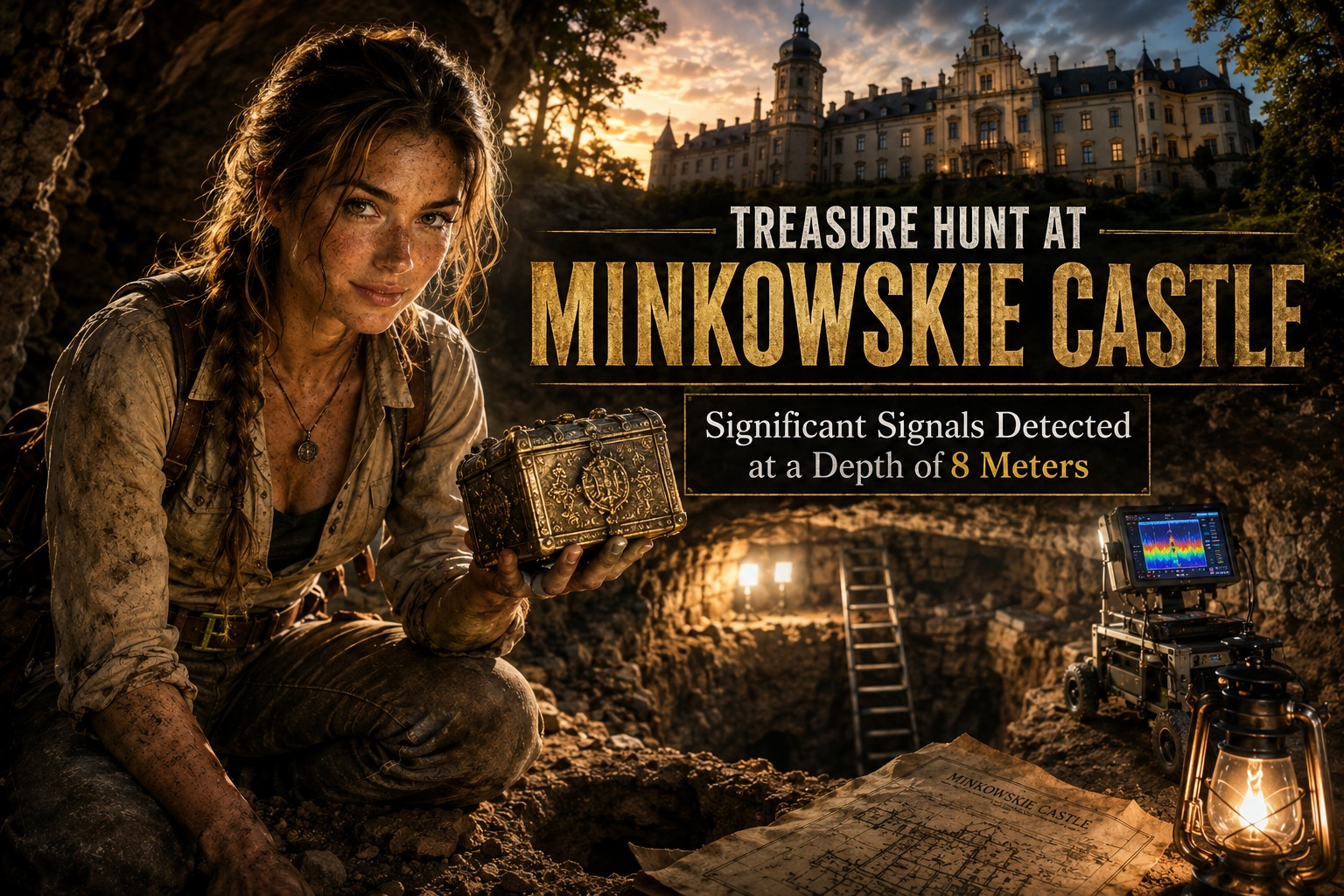
Minkowski Castle… Is this historic building now a witness of the treasure hunt?
Minkowskie, Poland – The search for the legendary legacy of a certain Dr. Günther Grundmann and hidden assets of unknown value on the grounds of Minkowskie Castle has entered a new phase.
The palace has already seen a lot – will this now be the treasure recovery of the century?
What lies hidden 11 metres below the former orangery of Seydlitzruh Castle? We’ll find out in a few weeks’ time.
Minkowskie castle (1937 – 1945 known as Schloss Seydlitzruh) holds a rich history in the Lower Silesian district of Namslau (now Namysłów, Poland). The Baroque palace was constructed between 1765 and 1784 on the foundations of an earlier Renaissance manor. It was commissioned by the legendary Prussian hussar general Friedrich Wilhelm von Seydlitz, one of King Frederick II’s closest military confidants.
Friedrich Wilhelm von Seydlitz, Frederick the Great’s legendary Prussian cavalry general, lived roughly 250 years ago. Renowned for reckless courage and tactical brilliance, he decisively shaped victories like Rossbach during the Seven Years’ War
8 October 2026: Amazing News about the treasure:
In an elaborately secured excavation shaft approximately 8 meters deep, the team has discovered promising leads: Precise measurements with a metal detector are showing strong, unambiguous readings directly at the lowest level of the structure.
It may well be that, in the next few days, the spectacular breakthrough will take place and sensational news about the Nazi treasure from Minkowskie Castle will be made public….
Amazing footage of the treasure hunt…
Forecast
If everything goes according to plan this is what the treasure recovery could look like at the end of October 2026
The treasure hunt has led many people to dig here. They all gave up. Except for the Silesian Bridge Foundation
Precision work at extreme depths
The conditions on the ground are almost impossible to tackle with just a spade and a shovel. State-of-the-art technology must be used here, which costs several thousand dollars a day…
Heavy machines are needed to get down to -11m (where the signal is obviously matching with the treasure)
The treasure hunt at Minkowskie Castle has reached an intriguing stage. The reported signals at a depth of eight metres are encouraging, but they do not yet prove that valuable objects are buried below.
The former orangery of ‘Seydlitzruh Castle’: Before excavations could begin, the protective shoring had to be installed with enormous effort… Minkowskie Castle was built from 1765 onwards…, since 1945 nobody was taking care for this beauty …
To expose the foundations and underground structures of the castle grounds, massive earthworks and the securing of the pit with steel sheet piles were necessary. Using the search probe at this depth demands the utmost concentration: The equipment filters out targeted electromagnetic signals from between mud, groundwater, and meter-thick layers of concrete and soil.
The measurement results indicate more substantial metal accumulations located beneath the remaining soil layer. Such stationary signals in undisturbed depth layers reinforce the suspicion that historical depots or buried cavities have been encountered.
An observer from a local newspaper says:
“When you’re standing down there in the gushing excavation pit and the detector is registering such a clear signal at a depth of eight meters, it sends shivers down your spine. The professionalism and dedication of the entire team is fantastic. I’m keeping my fingers crossed for the Silesian Bridge Foundation that all their years of hard work will finally pay off!”
A historical puzzle piece
One of the brave treasure hunters looks hopefully into the camera: “We will get it…”
The gradual uncovering now requires careful digging and pumping out of the flowing water. Each detector reading brings the excavation team a step closer to discovering what was hidden beneath Minkowskie Castle during the chaos of war. Work continues under tight security while the precise identification of the located metal objects is pending.
‘The construction workers and engineers at Minkowskie Castle have developed an incredibly precise process, respect!’
Pawel R. is a historian and archaeologist who has been following the entire process for years. He draws the following conclusion:
With immense effort, the Nazi treasure, which has already been located, is set to be recovered soon…
“The Silesian Bridge Foundation deserves credit for pursuing a complex investigation that requires patience, technical expertise and considerable resources. Its chances of success will depend on what lies beneath the excavation floor and whether the team can safely reach it before a heavy winter storm and snow will interrupt the lifting process…”
The Sileasian Bridge Foundation will keep you up to date…
What impact is the treasure hunt having on the tourism industry in Lower Silesia?
Little villages have more visitors and even hotels benefit from the Minkowskie Castle Treasure hype…
The treasure hunt’s massive delay turned a brief media spectacle into an extended stay for international press, researchers, and curious tourists, causing hotels in the Namysłów and Wrocław region to be fully booked for months in advance, with many guests extending their stays or planning return visits.
Who wrote this article about the treasure hunt at Minkowskie Castle?
‘The area at Minkowskie and surroundings shown here offer an incredibly deep insight into (German) history and are ideal for the curious … and treasure hunters’
Views:3,112
Related to the topic:
Decade’s biggest Treasure Hunt revitalizes Lower Silesia tourism How a massive delay in the most famous treasure hunt of the decade is helping local hotels achieve significant jumps in turnover... Minkowskie castle (1937 - 1945 known as Schloss Seydlitzruh) holds a rich history in the Lower Silesian district of Namslau (now Namysłów, Poland). The Baroque palace was constructed between 1765 and 1784 on the foundations of an earlier Renaissance manor. It was commissioned by the legendary Prussian hussar general Friedrich Wilhelm von Seydlitz, one of King Frederick II's closest military confidants. Von Seydlitz planned a stately residence in the style of the late…
Will a lost treasure spark a tourism boom in Lower Silesia? Lower Silesia, Poland, offers a compelling mix of history, mountains, and culture. Visitors explore majestic castles like Książ and the UNESCO-listed Czocha, hike the Karkonosze range, and discover WWII underground sites. Wrocław, the vibrant capital with its gnome statues, is a hub, while spas like Polanica-Zdrój offer relaxation. It’s a land of many rare and often hidden treasures… The area around Wrocław is also worth exploring Minkowskie Castle (probably 1940) The area around the former town of Namslau (Namysłów) is tranquil. It lies in the heart of the Silesian Lowlands. The region enchants visitors with its picturesque natural scenery and fascinating history. Surrounded by idyllic forests and…
Gambia: With up to 30°C in winter, the country is an affordable alternative to the Canary Islands Inexpensive flights are available via London, Brussels, Amsterdam and Barcelona, starting at around $ 350 return (from Oct - April, a lot of airlines are offering flights, in summer it's slightly more...). Interesting facts about Gambia: From Dakar, you can fly to Banjul in just 30 minutes with an ATR 72 turboprop, consuming around 1,000 litres of kerosene per flight hour... Gambia can be reached from Europe in around six to seven hours by direct flight, usually via Brussels, Barcelona or London. Prices start at around US $ 170 each way. Bargain hunters can also…